nr. 127 / 11 prill 2009


|
Blood-feud,
this medieval killer of modern times Today
and the future, in self-justice sense, have never had, it has not and it will
never have any positive chance to change for the good of civilization, tolerance
and coexistence in peace and harmony between people. Raised amongst
Albanians, not as much as a form of justice in the conditions of a lack of
State, but to give place to the “dividit et imperam” philosophy, the blood-feud came and stayed
preaching murder as the only way of survive of honor. Wherever Albanians
live, in Kosovo, Montenegro, Macedonia, Albania, this shadow is still running
by night, causing wail and making tombs. What makes an imperative for the
present of working of blood-feud as a self-justice, springing from the Canon
of Lekë Dukagjini,
the so-called “The Canon of the Mountains”, and what concerns at
the same time every form of State, in the way of struggle to integrate in the
Euro-Atlantic structures, NATO and European Union, is stopping this medieval cruelty. Theoretically and practically, all the
initiatives resulted in fail. No matter how the hand of the State tried to be
unmerciful to condemn the crime, according to the followers of the
tradition-right, it is the punishment of the law, while they have the
punishment of the Canon.
The
life of the families in blood-feud looks like a Purgatory inside Hell. Tears
and pain are the puzzle that completes the sad picture, that picture that is
hanging on in our civilized conscience. Wail and cry follow with the shadows,
the past and the present of many Albanian families. All the initiatives of
NGO groups and the strong hand of the State to punish murders resulted in
fail. In their eyes, the Canon is the only legal right that makes
“justice”, no matter it is medieval. The law is insufficient in
all the forms of State, whenever Albanians live. The “Shqipëria Etnike”
journal has often treated this phenomenon being a tribune of preaching of
tolerance and coexistence, forgiveness and leaving this phenomenon to the
past. But it looks like blood-feud is and will be the only
“justice”, despite the aspirations of the civilization of
today’s generation. None can speak about the victims of this medieval
killer, than the victim itself. The
road to Kosovo sends us to the family Sollova, in
the Municipality of Kastriot, of Obliq. We went to bring this message to a family living
closed-in, and here’s what Sofije Sollova, the Murat Sollova’s
wife, says: “Please listen to these words, please, for we’re in
great trouble. We’re not only badly reduced, but our dears are spread
all over the world”. She spoke while crying and drying her tears. Telling
us about her beloved son, Fadil Sollova,
she continues: “The enmity with the family of Haki
Krasniqi, since 1997, caused me to miss him so
much. In the beginning of that year”, she says, “for property
problems, the uncle of Fadil was killed, and since
then, our families, the family of Murat Sollova and
that of Haki Krasniqi,
are in blood-feud. According to the Canon of Lekë
Dukagjini, blood wants blood, and the bullet
demands bullet, son after son, man after man, until there is not any man at
all in the house. In this situation”, continues Sofija,
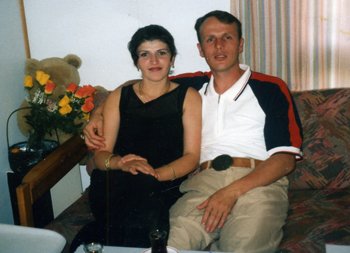
while looking somewhere at the corner of the room where is hanging on a
picture of the family, “our son had to leave. Between two bad things he
had to choose the littlest. If he was here, the family Krasniqi
would have killed him to take revenge. Though he wouldn’t like this to
continue, it would be impossible for him to stand above the tradition, above
the Canon”, says Sofije for the journal.
“In this situation, he couldn’t have any other choice, but
emigration, for him, his wife and their four children” concludes Sofije, while with her shacking hands holds a
handkerchief to dry her tears falling down to her lips. We
leave that house, those eyes that are always dropping tears and that voice
hoarse of crying. The shadow of life was living within those cold walls. From
behind the windows of those houses it looked like there were guns and not
eyes watching. This is part of many sad Albanian realities in the after-war
Kosovo, in the newborn Kosovo, in the Kosovo aspiring to be recognized by the
States that didn’t yet, in the Kosovo that wants to replace coexistence
with Serbs, like the prosecuted with the prosecutor. Blood-feud
came to remain as a witness of the past, as a traditional right that was held
forth that was born for self-justice because of the missing of State. It came
to kill peace between people, to divide them, to erase families, somewhere
for the property, somewhere for the honor, somewhere for a word and somewhere
for a watercourse. Nevertheless, the dresses of those killed for blood-feud
are saved by their mothers in the closets, to be washed only when the blood
is paid. Men smoke and oil their guns until these will bear death. Children
listen to histories of blood-feud and death, bravery of struggles and men,
from their grandparents. Doesn’t
it look like a medieval picture named “Blood-feud”, without
light, violent, without color, cold, sad, a picture that none would like to
see in an exposition. This indeed is the reality of tens and hundred of Albanian families in Albania, Kosovo,
Montenegro and Macedonia. editor office |